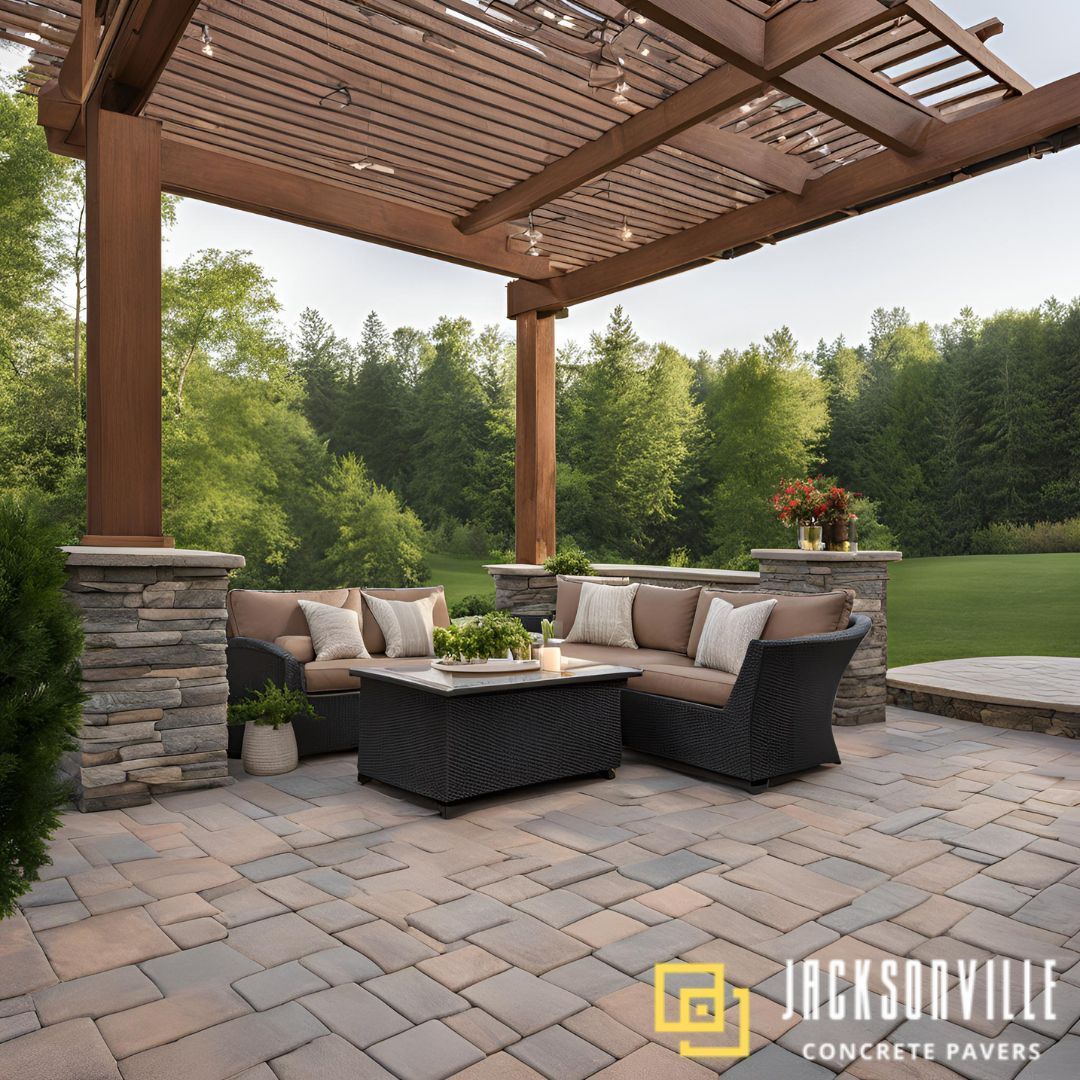
Hurricane Season & Concrete Pavers: Are Your Outdoor Surfaces Storm-Ready?
Most Jacksonville homeowners spend the days before a hurricane stocking up on water, taping windows, and pulling lawn furniture into the garage. Almost nobody thinks about their paver patio — until the morning after, when half of it is 30 feet across the yard and the joint sand is gone. After watching the 2024 season hammer the First Coast with Beryl, Debby, Helene, and Milton, we've spent more time on post-storm repair calls than we'd like. The good news is that concrete pavers hurricane preparation is mostly a 30-minute checklist. The bad news is that homeowners who skip it tend to pay for it in four-digit repair bills.
This guide walks through what actually damages paver patios, driveways, and pool decks during a Jacksonville hurricane, what to do in the 72 hours before landfall, how to assess damage after, and what your homeowners policy will and won't cover.
What Actually Damages Concrete Pavers in a Hurricane
Pavers are heavy, individually-set stones — a single 80mm Belgard or Tremron paver weighs roughly 11 pounds. They are not, in themselves, easy to move. The damage almost always comes from one of four mechanisms, and understanding which one hit you tells you exactly how to fix it.
Wind Uplift on Loose Pieces
Hurricane gusts in Jacksonville routinely hit 90-115 mph, and Cat 3+ landfalls go well past that. A planter, grill cover, or patio umbrella that catches the wind becomes a battering ram — we've pulled grills out of pool decks where the legs cracked through six pavers on impact. Loose perimeter pavers along a step-down or pool coping can lift directly if joint sand has eroded and edge restraint has failed. A field paver in the middle of a patio almost never lifts; the edges and corners are the failure points.
Flying Debris Impact
Roof tiles, fence boards, palm fronds, and the neighbor's trampoline cause most of the cosmetic damage we see. Concrete pavers are tough — an 80mm unit has 8,000+ psi compressive strength — but a 2x4 traveling at 100 mph will chip a corner, crack a face, or punch through a 60mm patio paver. Damage is usually localized to two or three units; a simple swap if you have extras.
Saturated Subgrade Settlement
The silent killer. When a storm dumps 8-15 inches of rain on already-saturated Jacksonville soil and the St. Johns system is overflowing, the compacted limerock base under your pavers can liquefy if drainage isn't right. The pavers don't move during the storm — they settle two weeks later when the ground dries and consolidates unevenly. You wake up to a half-inch dip in front of the sliding door, or a pool deck tilted back toward the house.
Joint Sand Washout
The polymeric sand between pavers locks the system together and prevents water intrusion into the base. Standard play sand washes out in a heavy thunderstorm, let alone a hurricane. Even good polymeric — Techniseal HP NextGel, Gator Maxx G2, SEK-Surebond — erodes at the surface when water sheets across the patio for hours. Once the sand is gone, the next storm finds the base.
Why Properly Installed Pavers Usually Survive
If your pavers were installed correctly, they're designed to act as a flexible system that flexes with the load instead of cracking like a poured concrete slab. There are three reasons a good install rides out a Cat 2 with cosmetic damage at worst.
The Interlocking Pattern Does the Work
A herringbone or running-bond pattern distributes load across many units. To lift one field paver, the wind has to overcome the friction of every paver locked against it. The system is only as strong as its weakest perimeter.
Polymeric Sand Binds the Joints
Good polymeric sand, installed properly and activated with the right amount of water, hardens into a flexible matrix that resists water intrusion and lateral movement. This is the biggest difference between a 1990s paver patio that fails every storm and a modern install that doesn't.
Edge Restraint Integrity
Plastic or aluminum edge restraint spiked into the base around the perimeter keeps the field from spreading. Concrete edge restraint is better and is what we install on storm-exposed pool decks and driveway aprons. When edge restraint fails, the whole field starts to migrate — joints widen and pavers tilt at the perimeter first.
The Pre-Storm Checklist (72-Hour Version)
Run this list when a named storm enters the cone with Jacksonville in the 5-day track. It takes most homeowners 30-45 minutes and prevents the majority of avoidable damage we see post-storm.
Clear Everything Movable
Pots, planters, grills, smokers, patio furniture, umbrellas, kid toys, hose reels, decorative rocks — anything not bolted down goes into the garage or shed. If it won't fit, lay it flat against the house on the leeward side and lash it. The biggest cause of avoidable paver damage in Jacksonville hurricanes is heavy objects becoming projectiles.
Check Joint Sand Level
Walk the patio. If you can see the bevel on the side of a paver, the sand has eroded below the chamfer and the joint is vulnerable. Sweep dry polymeric sand into low joints, but do not activate it with water if rain is forecast within 24 hours. A bag of Gator Maxx G2 runs about $40 at Home Depot and covers 80-100 sq ft of joints.
Secure or Remove Pool Deck Furniture
Pool cages and screen enclosures fail in major storms. Once the cage is gone, everything inside it becomes a projectile. Aluminum chairs in a pool become anchors that crack coping and pop pavers as the wind whips them around the perimeter.
Photograph Current State for Insurance
Walk the property and take 40-50 timestamped photos: overall patio, driveway, pool deck, each elevation of the house, close-ups of any existing minor damage. "Before" photos taken 48 hours before landfall are the strongest evidence you can have if a claim gets contested later.
Verify Drainage Path Is Clear
Clean gutter downspouts, scoop leaves out of channel drains, make sure French drain outlets aren't buried under mulch. Water that should flow off the property will instead pond on your patio and saturate the base. Standing water for 48+ hours causes the settlement that shows up weeks later.
Check Edge Restraint
Walk the perimeter and look for spikes that have backed out, plastic edging exposed above grade, or soil eroded away from the restraint. Tap loose spikes back in. Cracks in concrete edge restraint are a post-storm repair item — note them now.
Document Tree Risk
Photograph any tree limbs hanging over the patio. If a limb takes out a section of pavers during the storm, you'll want to show the insurer the limb existed and was clearly above the damage zone.
Watch vs. Warning: What Changes
The National Hurricane Center issues a Hurricane Watch when tropical-storm-force winds are possible within 48 hours and a Hurricane Warning when they're expected within 36 hours. Your actions should shift accordingly.
During a Watch (72-48 Hours Out)
Planning and prep window. Top off polymeric sand, run the photo documentation pass, verify drainage, identify what's going inside vs. getting lashed down. Buy supplies now — extra polymeric, plastic sheeting, ratchet straps, tarps. Stores get picked clean once a Warning is issued.
During a Warning (36-12 Hours Out)
Execution window. Everything movable is inside or secured. Stacks of loose pavers from previous projects are projectiles — move them. Cover any cracked pavers with plastic weighed down by intact units to keep water out of the base.
Final 12 Hours
Paver prep is done. Don't try to tarp the patio in the rain — it doesn't work and it's how people get hurt. Your install either survives or it doesn't; your job now is to be ready to assess and document afterward.
After the Storm: Damage Assessment
Wait until the all-clear, then walk the property with your phone. Photograph everything before you touch anything. Then look for these five categories of damage in order of severity.
Settling and Dipping
Lay a 4-foot level or a straight 2x4 across the patio in multiple directions. Look for new dips, especially near the house, around drains, and at the perimeter. A settling of 1/4 inch is cosmetic. Anything over 1/2 inch over a 4-foot span means the base has shifted and you need a re-set. Pool decks that have tilted back toward the house are urgent — water that pools against the foundation causes real damage fast.
Joint Sand Loss
Look at the joints. If you can see the bevel chamfer or the bare base beneath, the sand is gone. Localized loss is a sweep-and-activate fix you can DIY. Widespread loss across a whole section means water was channeling through the patio and you may have base damage underneath.
Edge Restraint Failure
Walk the perimeter. Look for restraint that has lifted, spikes pulled out, or sections of perimeter pavers that are tilted outward or fanning apart. Edge restraint failure is the most common storm damage we repair, and it's almost always urgent — once the perimeter goes, the field will follow within months.
Lifted or Displaced Pavers
Pavers that have lifted, shifted laterally, or are visibly out of plane with their neighbors. Count them, photograph them, note any that are cracked or chipped. Stack any displaced pavers neatly off the patio so you don't lose them — most patios can be re-set with the original units.
Sinkholes and Voids
Watch out for any soft, sunken, or hollow-sounding spots. Tap suspect areas with a rubber mallet — a hollow ring means there's a void in the base. This happens when water has washed base material out from under the pavers, usually exiting at a downhill perimeter point. Sinkholes are immediate professional repair items. Don't walk on them, don't park on them.
What Homeowners Insurance Actually Covers
Florida homeowners policies treat hurricane damage in two distinct buckets, and the bucket your claim falls into determines whether you're covered.
Wind Damage Is Generally Covered
Damage caused by wind — including wind-driven debris impact, displaced pavers, and uplift — is covered under the standard wind/hurricane peril of most Florida HO-3 policies. You'll pay your hurricane deductible (typically 2-5% of dwelling coverage in Florida, not the flat all-perils deductible) before coverage kicks in. On a $400,000 dwelling, that's an $8,000-$20,000 out-of-pocket before the insurer pays anything. This is why minor cosmetic damage usually isn't worth a claim, and major damage absolutely is.
Flood Damage Is Not Covered Under Standard Policies
If your pavers were displaced or your base was undermined by flooding — storm surge, river overflow, rising water — that's a flood claim, and you need a separate NFIP or private flood policy. Jacksonville's flood zones around the St. Johns River, San Pablo Creek, and the Intracoastal flood routinely in major storms, and standard homeowners policies will deny the claim. Know your flood zone and whether you're carrying flood coverage before the storm.
The Wind vs. Water Question
When both wind and water hit the same patio, claims get contested. Pre-storm photos, post-storm photos, and a detailed write-up from your installer matter enormously. We're often asked to write damage assessment letters for clients distinguishing wind-displaced pavers (covered) from flood-undermined base material (not covered without flood insurance). Be ready for the insurer to push as much damage as possible into the flood bucket.
HOA Documentation Requirements
Most Jacksonville-area HOAs require notification of damage and pre-approval before significant exterior repairs. Send your HOA documentation early — same photos you sent the insurer — and get written approval for any paver work before the contractor starts. Otherwise you risk being forced to redo work at your own expense.
Repair vs. Replace: When Settling Becomes Structural
Most post-storm paver work is repair, not replace. The threshold for replacement is when the base itself has failed across a large enough area that piecemeal re-setting won't hold. Jacksonville Concrete Pavers typically sees three tiers of damage on the same Jacksonville hurricane.
Tier 1: Sweep, Top Up, Reactivate
Joint sand loss without paver displacement. Sweep in fresh polymeric sand — Gator Maxx G2 or Techniseal HP NextGel, around $40-50/bag — activate with a fine water mist per manufacturer directions, let cure 24 hours. DIY-able for a handy homeowner. Professional cost: $1.50-$3.00/sq ft.
Tier 2: Lift, Re-Level, Re-Set
Localized settlement or displaced pavers over a section. Lift the affected pavers, re-screed the bedding sand to grade, re-set, sweep and activate new polymeric. This is the most common storm repair. Professional cost for a typical 100-200 sq ft area: $800-$2,500 depending on access and base condition.
Tier 3: Tear Out and Rebuild
Base failure — significant settling over a large area, voids in the base, or repeated re-setting that won't hold. The fix is to pull the field, excavate and re-compact the base with fresh limerock to proper depth (6-8 inches for patios, 8-12 inches for driveways), re-bed, re-set the pavers, and add concrete edge restraint where the plastic restraint failed. Cost: $12-$20/sq ft, which on a 600 sq ft pool deck runs $7,200-$12,000.
Pre-Installation Choices That Survive Storms Better
If you're planning a new patio, driveway, or pool deck in Jacksonville, the choices you make up front determine whether you're rebuilding after every major storm or just sweeping debris off the surface. Jacksonville Concrete Pavers recommends the following specs as a baseline for any installation within 30 miles of the coast.
80mm Pavers, Not 60mm
The standard 60mm (2-3/8 inch) patio paver is fine for inland areas without hurricane exposure. For Jacksonville, we spec 80mm (3-1/8 inch) pavers across the board — patios, pool decks, driveways. The extra mass resists uplift, the deeper interlock holds the system together, and the cost premium is usually $1-2/sq ft. Belgard, Tremron, and Pavestone all make 80mm options in popular styles.
Polymeric Sand, Always
Techniseal HP NextGel and Gator Maxx G2 are the two we use most. Both are wet-cast polymers that flex with the system and resist washout in driving rain. Avoid generic "polymeric sand" from big-box stores — the binder ratios matter and the cheap stuff fails after one or two seasons.
Proper Base Depth
Jacksonville soil is sandy and drains well in dry conditions but becomes unstable when saturated. We compact 6 inches of crushed limerock under patios, 8 inches under pool decks, and 10-12 inches under driveways, in 2-inch lifts with a plate compactor between each lift. This isn't where to save money — base failure is the single most expensive repair to fix later.
Concrete Edge Restraint
Plastic edge restraint is industry-standard and works fine inland. For Jacksonville pool decks and any field that abuts a step-down, lawn edge, or driveway apron, we pour a concrete edge restraint instead. It costs $4-7/linear foot more but it doesn't pull out in a storm, and it's the difference between "I lost three pavers on the corner" and "my whole patio is migrating toward the seawall."
Geotextile Fabric Under the Base
A non-woven geotextile fabric between the subgrade and the limerock base prevents fines from migrating up into the base under saturated conditions. It's $0.30-0.50/sq ft installed and adds years to the lifespan of the system in flood-prone areas. We include it standard on any pool deck or anything within a flood zone.
Frequently Asked Questions
Should I cover my paver patio before a hurricane?
Will hurricane wind actually uplift my pavers?
Does homeowners insurance cover hurricane paver damage?
How do I know if my pavers need to be re-set after a storm?
Can pavers be reused after storm damage?
You might also like